Thursday, January 28, 2016

Meet Me In the City: Bruce Springsteen at Madison Square Garden

            There are two pits for General Admission at Madison Square Garden: the one at the very front, allowing you the closest access to the stage; to get into this one, you had to show up early in the day and get a special wristband, and then come back later and be entered into a special lottery, and only if you were really lucky did you get shuffled into the pen containing the most dedicated fans around.  Then there’s the second pit, the one I’m in, a little further from the stage, holding all the general admission folks who couldn’t do the whole lottery thing, presumably because they got up at ass o’clock to get on a train from Boston and it’s technically a work day so they telecommuted all day from the aforementioned train and various Starbuckses and libraries around New York so they don’t lose their vacation days.  You know, I’m assuming. 

            Despite being further back, the energy in the second pit is palpable.  This is a bit of an unusual setup for me.  When I go to Drive-By Truckers or Blitzen Trapper shows, I’m right up front, usually touching the stage.  Back here, I expected things to be a little more blasé … but this is Bruce Springsteen.  At least in the leadup, everyone back here is pumped and ready.  Of course there are two gigantically tall humans in front of me, but if I stand just right, they serve as a window rather than a door, and I’ve got a direct sightline to the center mic.  Now, if only Bruce stays in one place the whole night, I’ll be fine.

            He takes the stage about an hour after I arrive and the place goes nutso berserk.  Everyone on their feet, arms in the air, cheering either inarticulately or shouting the name that sounds too much like “boo!” to the unsuspecting ear: BRUUUUUUUUUCE!  Every time I tell myself I won’t do it.  Every time I’m wrong.  Hell, I’m wearing the shirt of the show to the show.  I don’t care about being cool anymore.  I just want to have the time of my life. 

            Launching right into “Meet Me In the City” – one of the outtakes off The Ties That Bind: The River Collection – and Madison Square Garden is right there, already screaming the words along and knowing the call and response near the end of the song without having to be told.  It’s like when he went out for his first Rising show and everyone in the audience knew the words already.  Tears spring to my eyes because my emotional availability is sometimes a liability.  The band is in full form, chugging like a steam train down a track whose destination feels familiar but is never quite the same.  After “Meet Me” pounds to a close, Springsteen comes to that center mic, beautifully composed between the heads of my two Amazonian compatriots, and explains a little of what writing The River meant to him.  I’m not going to transcribe from memory, but the gist and the feeling was that this was the album about trying to find his place inside the world in which he lived.  The prior albums were all about being an insider, but The River was about finding yourself in a society in which you had to define yourself.  So that’s why, at least partially, it meant so much to me back in those dim days of 1993, when I lived alone and was searching, searching for some reasons and explanations as to why and how my life turned out this way. 

            Here’s what you don’t get from message boards, especially one as psycho bonkers as the Springsteen one: the feel of the place, the knowledge that you’re both a part of something big and that you’re experiencing this singularly, as an isolated person, and Bruce is singing directly to you.  He’s singing about cars and girls, two things I know so little about, but it all feels like my experience.  Out in the street, I walk the way I want to walk; I know about how the cool of the night takes the edge off the heat; hell, oo oo, I got a crush on you.  The message boards – boy howdy, guys; they’re all about conspiracy theories and how Bruce won’t stop lying to us and how the “well is dry” and it’s weird as fuck.  But here, in the thick of it, it’s nothing short of transformative.  How, in a fun little rockabilly song like “You Can Look (But You Better Not Touch),” can he perfectly address the weird nuance of being so sexually frustrated you feel mean?  That’s so specific and odd to sing about, and he does it with the same smile and incongruous joy that he would sing about existential futility in “Dancing in the Dark.”

            During “Hungry Heart” – he always lets the audience sing the first verse entirely, then he repeats it, because baller – he tramped off the stage and up to the riser between Pit One and Pit Two.  I was so close – almost close enough to touch, but we all remember that time during the Rising tour when I reached up and grabbed his hand in the middle of “Mary’s Place” and was so awestruck I didn’t know how to let go.  He ended up shaking me off without skipping a beat.  I didn’t take many pictures of the show – I wanted to live inside it – but I took a picture of him right next to me, before he leapt off the riser and crowd surfed back to the stage.  He’s in his sixties, guys. 


            I will give a shout-out to some of the denizens of the Second Pit, who paid the same amount I did to get here and who decided that their conversation was far more important than Bruce Springsteen.  I knew it would happen during some of the slow songs, but come on, folks, I’m trying to wrap myself up in the song that perfectly encapsulated my previously complicated relationship with my father, I don’t need to know about what Helen did at that PTA meeting.  I was on the verge of asking, “I’m sorry, is Bruce Springsteen interrupting your night?” when someone behind them shouted, “Hey shut the fook up!  New York, you’re my savior.

            Note: the song, “The River” is perfect in every way, especially live, and especially when the people in front of you are as invested as you are.  I’m pretty much sure tears came to my eyes during the entire first two sides of album, and we weren’t even on “Point Blank” yet. 

            Given the second pit’s macroaggressions, I was prepared to suffer through the final three-song suite, which are all slowish numbers that require a little more attention and care.  I think Springsteen must have anticipated that, because he recast them: “The Price You Pay” is epic enough on the album, but in concert, it’s another “Backstreets,” it’s another “Born to Run.”  Here, live, it attains the Biblical promise and intent of the lyrics, even though it’s just about people trying to get by.  The album’s final love song, “Drive All Night” has the potential to be dismissed; long stretches are just repetitions (“You’ve got, you’ve got, you’ve got, you’ve got my love, girl; you’ve got my love”) or frankly bizarre declarations (“I’d drive all night, just to buy you some shoes.”)  What happens here is that the song becomes all about buildup, slow, meditative, desperately and subtly erotic … and then the band crashes in, and it’s all release.  It’s a song that took me awhile to understand on the record, but here in this setting, it’s the closest to auditory sex Springsteen gets this side of “I’m On Fire.”  He finished off The River with a somber, bleak rendition of “Wreck On the Highway”: no gussying this one up, no concessions for an arena audience.  It gets dark and stays dark, because that’s the way he wants you to feel this one.  If he’d decided to play the entirety of Nebraska after this one, no one would blame him. 

            He didn’t, though, maybe because he knew we all needed a little cheering up.  “So that’s The River,” he concluded, and then hit the place with a one-two-three punch of “She’s the One,” “Candy’s Room,” and “Because the Night.”  Everyone was up and dancing.  One of the flannel giants in front of me turned to me and said, “Can you believe how cool this is?”  “I can’t!” I shouted, and then we both joined in the chorus. 

            Then, oh man.  There are moments that come into your life that are so elevated and unique that you can barely credit them as they’re happening.  My favorite song of all time is “Brilliant Disguise,” a song whose meaning has shifted for me since I first discovered in when I was 18, but has never stopped meaning just as much to me.  It’s the intersection of surety and identity, and how those two things are never as solid as we think they are.  In Springsteen’s book Songs, he refers to this as the sequel to “Stolen Car,” which he’d played earlier during the River set, and hearing them bookending like tonight, it makes sense: “Each night I wait to get caught, but I never do” pairs so well, so hellishly well with, “so when you look at me baby, you’d better look hard and look twice / is that me baby, or a brilliant disguise.”  Who am I?  Why am I?  What the hell have I done?  

            I have never seen the song live, and suddenly, here it was, and I was this close, and those words I’d memorized over half a lifetime ago were drifting into me from the source.  I was unprepared and overwhelmed.  Never has not understanding who you are and what you mean to other people been so thrilling.   

            Then there’s the raucous bam-bam of “Wrecking Ball” and “The Rising,” two songs that the message board assured me were “over” and “not worth listening to” and “no one really even likes.”  You wouldn’t have known it from everything going on in Madison Square Garden: everyone from the pits to the nosebleeds on their feet, singing along and dancing if they had a mind.  This occurs to me over and over, but it never fails to stun and thrill me: the audience’s total embrace of Springsteen’s newer material is nothing short of astounding.  I wouldn’t say “Wrecking Ball” got the exact response as “Thunder Road,” which came next, but it thrilled everyone to their feet and everyone knew all the words.  Is there any legacy performer for whom this is true? 

            We closed things out with Bruce spoonfeeding us what even the casual fans wanted: “Born to Run,” “Dancing In the Dark,” and “Rosalita,” with a grand finale cover of “Shout,” one final blast before we all had to return to the normal lives we lived that aren’t interpreted by a master songsmith.  I couldn’t leave for a little while, too enthralled by what I had seen and experienced to really move.  I wanted to absorb it.  I wanted to keep feeling it. 

            Of course these moments are fleeting.  They have to be.  No one can live forever on nerve endings and elevated consciousness.  Eventually we come back down to earth, and while it’s a somewhat duller, somewhat less thrilling life in the shadow of three and a half hours of pure passion and excitement, we take at least a little of that with us, and spread it into the world.  If that’s the price you pay, I can live with it. 


Friday, October 16, 2015

All I Wanted Was to Rock and Roll

One week ago today, I was on a plane hurtling through tailwinds and contending with an endlessly shrieking three-year old on my way to Walt Disney World, where I celebrated my friend Joe’s birthday in our customary style: Disneying the shit out of it. Our friends Robert and Brad and Kay and Ricky joined us incrementally, but mostly it was just me and my buddy Joe. We dined. I got drunk in a tiki bar. Like super drunk. Somewhere in there, I found time to head out to downtown Orlando and take in what was probably my last Drive-By Truckers show of the year. They rocked my face off, and Patterson Hood not only dedicated a song to me, he also mentioned me on Facebook, so my life in rock and roll was already soaring.

            A day after I got back from Disney, I headed out to the Sinclair in Harvard Square to take in my third Blitzen Trapper show ever.  Third.  That seems insane to me, because much of the last year and a half has been spent immersed in their music. I became the fan that wrote their Wikipedia page and got permission to write a book about them. Half-measures don’t suit me. When my friend Ian and I caught them last year in DC, we only did it because they were opening for the Truckers; I knew “Furr” and “Black River Killer” and that was where my knowledge of Blitzen Trapper ended.  The day after the first show, Ian and I went out and bought three more albums. We were hooked. I was nuts hooked.

            So now I was at the Sinclair and, look, I don’t know how these things work. My approach to Truckers shows is showing up an hour or more early so I can make sure to hug the rail with my DBT buddies.  When I go to Springsteen shows that are general admission … well, I’ve been known to hang out for sixteen hours and read The Adventures of Kavalier and Clay, because waiting most of a day to get into the pit at a Springsteen show is a surefire cure for not reading Pulitzer Prize winners.  I was completely unprepared for how a Blitzen Trapper show functions. I got in line a half hour before almost anyone else. I got to the front and grabbed the stage. No one else was copying me. Maybe it was the Cambridge hipster thing. People wanted to be there, but, like, didn’t want to seem excited to be there? Screw it. I’m a lone wolf. I’ve got enthusiasm in buckets.  

            Seeing my first full Trapper concert on my home turf was the circumstance of some cruel fate. Last year, I’d been able to see them and the Truckers on the same bill.  Now, they were playing in New York City on the same day as the Truckers’ Orlando show, and as much as I love NYC, any excuse I can make to go to Disney with some of my best friends is an excuse I will make. Besides, I think I prefer the more dramatic, narrative feel of them showing up in my hometown. My first show after becoming a megafan, and it’s right here in my backyard.  Dig it.

            Two Red Bulls in and eyes wide and nerves jangling, I watched opening band, The Domestics – also from Portland – take the stage. Assessment: good stuff. Steeped in classic Britpop sounds; they seemed to have studied at the feet of The Kinks and The Turtles. Also two of five band members were foxy beyond. In the parlance I tend to use on Twitter: hotness game on fleek, trill af.  On night three, I let the drummer know where he stood on my yum-o-meter and he was real Portland about it. I bought their album, I get to have an ogle.

            Blitzen Trapper took the stage and the uncritical, overwhelming bliss gripped me at once. My interest in this band has been on a steep and steady grade ever since discovering them and this moment – stopped in time, steeped in importance – served as both a culmination and a reward. Before even playing a note, the band’s camaraderie and charisma flowed off the stage in palpable waves. Their new album, All Across This Land, had come out the week prior, and it was The Ghost of Tom Joad and it was English Oceans and it was Stunt: the first new studio album since I got into a band. I’d been careful to listen enough to let it seep into me but not so much that I got sick of the new songs. Plus, I needed to be open enough to their live interpretations. Everything was launching.

            Eric Earley, lead singer, stood at the microphone and let a low rrrrr sound drag out: part growl, part engine revving up. Then he opened up and the band did too, as the guttural precursor ramped into “Rock and Roll Was Made For You.”  Its deceptively happy music and somewhat generic title belied its darker lyrics, saturated with addiction terminology – rock is for blacking out, rock leaves its own track marks up and down your arm. It starts out midtempo and then explodes into a full-out rocker; it was a mission statement for the album and it is for the show. Rock and roll will take no prisoners, will offer no quarter. It will rule you, it will wreck you, it will make you travel to three different cities and stand in the front and scream until you’re hoarse.

            The set list that first night oscillated between folk and country funk and rock so 70s it would pulse only in sepia for people with synesthesia.  They made room for my two favorite songs, “Love the Way You Walk Away” and “Big Black Bird,” which served as the big rollicking closer.  Along the way, not one but two Beatles covers: “Come Together” and “You Never Give Me Your Money,” both of which traded off verses between Earley, keyboardist and guitarist Marty Marquis, and drummer Brian Koch.  I can’t be aloof about this: bands trading verses is one of my weaknesses, even more so than hot drummers.  Not only were they swapping vocals, but they have a way with three-part harmony that will make your heart burst and your knees weak. In the encore, Earley, Brian, and Marty stood at the front of the stage and took on a half-acoustic, half a capella cover of Townes Van Zandt’s “If I Needed You.” Sweet country sounds, right here in the midst of Harvard Square.

            After the show, I met with delightful bassist Michael Van Pelt, who has been my primary contact in my journey through Blitzen Trapper’s past and present. All I can say is that I’m getting better talking to people I admire; I didn’t fall down or palpitate once, unlike the time I met Bernie Wrightson at ComicCon and felt compelled to show him my Cycle of the Werewolf tattoo and point at it and be all, “You made this! Look, this is something you made!” I’m an embarrassment to humans. Mike and I gave each other a hug and I told him how much the band rocked, because I’m way more articulate on paper than in real life. I bought a shirt and took it home and tried to sleep because I had to be up early to fly to Philadelphia for Night Two. 

            Philadelphia is … well, let’s just say that my Air BNB was very nice, and I was more amused at the cow pelt on the wall than disturbed. Also, I was the only customer in the Indian restaurant next door, so I self-consciously read my 33/13 book on Neil Young’s Harvest as I made the entire kitchen staff cater to just me. To give you an idea of my neighborhood: I had to walk forty minutes to find a Starbucks. It was fucking worth it. 

            The thing about the Sinclair in Cambridge is that it’s fairly new and modern. Big stage, fairly expansive room, great little bar. All the good parts of hip without any of the drawbacks, like a hot guy with a funky mustache who likes stuff sincerely.  In contrast, Johnny Brenda’s in Philly is as old school as possible.  It’s a little bar and tavern, in which I ran into Eric Earley and also, insanely, had a normal conversation with him. What was happening with me?  I may have also told him that the band rocked the night before, because I’m a dork.  Can I point out how nice everyone in the band is, by the way?

            My friend Clams, aka David, a Drive-By Truckers buddy, joined me for a drink or two (it was two and it was ill-advised, but Johnny Brenda’s had no Red Bulls which … I mean, come on, Philly. I need caffeine.) and then we headed upstairs to the concert room. Good lord. If the band wanted vintage verisimilitude, here it was. Tiny stage, tiny room, ample balcony, beads on the walls; it was like walking into a time machine to a time when clubs all looked like your cool uncle’s rec room. I loved everything about it.

            The band leaned more heavily on newer stuff, and it was awesome to hear some of that airing out.  The snaky, brooding “Love Grow Cold” pops live, its almost sensual desperation alive and bitter.  “Nights Were Made For Love” has become one of my new live favorites, Earley’s vocal jumping in just as the instruments crash together, nostalgic urgency shaking those beads on the walls and the feet on the floor.  Someone drunkenly shouted, “Don’t play your new stuff, play your old stuff.” The crowd laughed it off and the band seemed to understand that Drunky McSadlife didn’t speak for the rest of us.  We were here for “Furr” and “Black River Killer,” sure, but we kept coming back for the new stuff.  And hey, we got “American Goldwing,” and I could have been happy with just that.  Someone else requested “Gold for Bread,” and Earley said, “Oh man, I forgot that one. We’ll have to rehearse that for a later show.”

            The later show was the next night. I took a train down to Washington DC, my whole Blitzen Trapper live experience coming full circle. I met my buddy Ian and we spent the afternoon working (this whole telecommuting thing allows me to live a rock star lifestyle and still have an office drone job) and then made our way to the Black Cat.  Again we were among the first there, and it almost didn’t matter: the floor was huge.  We ran into another fan at the front of the stage and he was just as stoked as we were, but he didn’t like the Beatles so as it turned out he couldn’t be fully trusted.  Ian had been beside me when we first heard Blitzen Trapper live; they started off with “Fletcher” then, and they brought it back tonight.  Again, I shut my critical functions off early and just let myself get lost in the music.  We got “Gold for Bread.”  We got “Big Black Bird” (absent from the night before). We got “Heart Attack” in an extended jam to close out the night.  And then it was over.

            I hung around after the show like a super creep, but Erik Menteer and Marty Marquis came up to me and thanked me for coming out to all these shows and supporting the band. I thanked them for, I think I said, “being so awesome,” because DOOOOOORK.  Then there was Mike, bassist extraordinaire, and we talked a little more and said bye for now, because it’s gonna be awhile before I see them again.

            Of course today’s a little bit hollow.  I mean, sure, I’m staging a big comedy show tonight and seeing Rocky Horror at midnight, but there’s no rock show.  They’re way down in North Carolina today and I’m back in Boston, leading my normal life. The normal life that includes writing novels and putting on comedy shows and getting tattoos. I may not have a normal life.

            Rock and roll was made for me. It's an important thing, like breathing and love. It’s a salvation and an addiction. It’s sin and it’s heaven. It lifts me up and keeps me internal. There’s little that’s more exhilarating than seeing a band you love play new music live, seeing it with friends sometimes, sharing the experience with dozens or hundreds of others there to try to get the same bliss as you.  Blitzen Trapper never shirked their duty, never wavered in their stated intent to rock my world. 

            In other words: you don’t need rock and roll to live, but without it, is it really living? Three different nights, three different cities, and hell yes was I alive.

Tuesday, October 6, 2015

Twenty Years of The Ghost of Tom Joad

On this day, twenty years ago, I left my tiny rooming house room in Quincy and got on the bus, then the train, then another train to get to the Cambrigeside Galleria, where I worked at the B. Dalton's in 1995. The air around the mall smelled of chocolate because there used to be a chocolate factory nearby. It's gone now. The B. Dalton's is, too.
I was first in line when Best Buy rolled its gate up and I ran in, running right to the CD section and snatching up the first copy of The Ghost Of Tom Joad I saw. Two women who'd come in behind me were doing the same thing. I'd gotten into Springsteen only two years prior; the newest albums were Human Touch and Lucky Town, which at the time I drank in like water. I'd gotten in by way of Nebraska, which was bleak and monochrome and exactly fitted the life I was leading. "Streets of Philadelphia" had come out recently and I'd fallen for that, and I'd grabbed Greatest Hits the day it came out, but this was the first brand-new studio album by Springsteen I would hear since becoming a fan.
I didn't have a Discman then (that came later). There was no immediate download or buying in bed. On the long ride back home, all I could do was read the lyrics, and man, did they make sense. So many of the songs were stories of people so desperate that they forgot they were desperate. In 1995, that was where I was. Who I was. I got back to my rooming house and turned on the CD player and plugged in the headphones I'd borrowed from my then-boyfriend's best friend, who had since died. I fell into The Ghost of Tom Joad, and it fell into me.
That record came out twenty years ago, when I was twenty and living on my own and struggling against every desire to give up. Tom Joad gave me hope in its hopelessness. I was on the edge of the world back then, tottering. The people I was listening about had fallen off, and there was never a hope of getting back. All I needed was to not fall off. I've come close a few times, but I always got back.
Thanks for being my reason to live for a little while, The Ghost of Tom Joad. And thanks for being one hell of an album.

Tuesday, September 29, 2015

Why I Write Books

             Currently, I’m caught in a limbo of fiction.  It’s a limbo I don’t particularly cherish being inside.  I've finished Eating Animals and I'm waiting till the start of National Novel Writing Month to begin the new book.  I've got plenty to do: editing two books and proofing yet a third, but it's not writing.  It's not creation.  So, as a stopgap: why I write these things.

I first started writing novels in 1999 … okay, wait.  That’s not entirely true.  I really started writing novels in 1991, when I wrote my first unwieldy horror/sci-fi novel called Mind of Darkness, because I’d heard of Conrad’s Heart of Darkness and liked the ring.  I was fifteen when I wrote it, and it was terrible … except, maybe, for a scene in which a possessed mother decides to straighten her scoliosis-afflicted daughter’s spine with a rolling pin.  That got me fired up and is the only thing in the book that still sticks in my head, twenty-four years later.  In senior year of high school, I gave novel writing another go and ended up with a novella called The Transmigration.  It was … all right.  Both books owed a great deal to Stephen King’s It (my then- and now-favorite novel) and both dealt with possession because that was apparently my bag back then.  This was a time in my life during which I was hanging garlic up around my bedroom windows, in case vampires decided to invade the suburbs.  I read horror comics and horror novels and my last date with a girl was going to see Freddy’s Dead: The Final Nightmare.  This was my frame of mind/reference.  I wrote spooky short stories for my composition classes and for my final thesis, I compiled a bunch of them into a short story collection.  I got an A-.  I think the minus was because I described sex a little too overtly in a story I called “Bound and Determined.”  You do the math. 

            It took me a long time to write another book, so I stuck with short stories.  Flashback: when I graduated middle school (this was apparently a big deal in my family), I got a typewriter and started typing up short-short stories with ironic titles and twist endings.  I was the O. Henry of the teenage set.  That practice largely ended when I had yet another fight with my monstrous stepmother, and she tore up all my stories and left them in a neat pile on my dresser when I came home.  A master of psychological and emotional horrors, was she.  Anyway, when I lit out on my own as a teenager and found myself ensconced in a dank, eternally beige rooming house on the wrong side of the tracks, my grandparents upgraded my typewriter to a word processor, and there I set about the task of continuing what I did in high school – writing short fiction.  None of it was very good.  A lot of writers thrive in down-and-out situations, but I faltered.  Junkies were ODing across the hall from me and old men were in the business of dying slowly in all the other rooms.  I got into writing bleak poetry and one time I saved a homeless guy’s life and he helped me discover Bob Dylan.  I worked at a bookstore and read and re-read Stephen King, and my friend Tracey got me interested in crime fiction and science fiction, so eventually I read that, too.  Robert Parker.  Orson Scott Card.  I tried to write a novel called Bridge Trip, but it went nowhere. 

            I moved out of the rooming house and into my own studio apartment and started writing short stories I was proud of.  A number of them made it into the first professional fiction book I got published, This Terrestrial Hell.  I wrote one story, called “Last Night at the Bear,” which was both inspired by my saving that homeless guy’s life and a Drew Carey (yes, that one) short story called “Tackling Jim Brown.”  It was my first non-horror story.  Things were clicking.  I tried to write a werewolf novel titled Canis Lupis but it was overly complicated and dull, and there was a woman in it named Devia, who was devious.  Yep.  Then I broke up with my boyfriend of five years.  I did it twice in one day because I was twenty-three and had a fluctuating sense of security.  Three weeks later, I started dating Shawn.  Two weeks after that, I started writing what would be my first novel.

            Shawn definitely had something to do with it.  The whole book, which I titled Spare Parts after a Springsteen song, is about relationships – a long way off of the horror short stories I’d been writing.  Part of that had to do with the William Goldman novel, The Color of Light, which I now recognize is something of a World According to Garp pastiche, though I hadn’t read Garp at the time and knew nothing of John Irving.  My thinking at the time was that I’d gone through a terrible breakup and I was having love issues, and why not write a book about people my age faltering and falling in love and apparently crying six times a chapter.  Plus, I’d recently read King’s On Writing and I was inspired.  Anyhow, I got the book finished in a couple months.  It wasn’t very long – barely 60,000 words – and it wasn’t particularly great, but it got me over the hump.  I wasn’t a potential novelist any longer.  I could write novels, grown-up novels.  I sent it to an agent who sent it to a publisher.  Both of them dropped me on the same day.  Ah, the fleeting feel of fortune. 

            I’m not going to say it didn’t hurt.  I spent probably a decade afraid to submit anything.  But it didn’t stop me from writing.  While waiting to hear from the agent, I inadvertently began a second novel, I’m On Fire, also after a Bruce Springsteen song.  I say inadvertently because I set out to write a short story.  What ended up happening was that a longish novel came out of it.  My first real horror novel.  A decade and a half later, I looked at it again, did a complete rewrite, and submitted it to Cemetery Dance.  They published it this year as an ebook.  The ticking timebomb of success is a slow one. 

            Meanwhile, more books.  I liked contemporary crime fiction, so I wrote a book called The Eighth Acre, with every intent on my hero, Wayne Corbin, becoming a series character.  After my second, much longer book about relationships (Open All Night, also named after a Bruce Springsteen song), I got to another Corbin novel, The Color of Blood and Rust.  By this point, I’d only been writing books two years and the ideas just wouldn’t stop coming.  Five books in two years.  I wrote my second horror novel, Wolves in the Black, and my first epic novel (over 200,000 words), Find the River in 2001.  River I wrote entirely in the first apartment I shared with Shawn.  I needed to keep my spirits up, what with 9/11 happening and it being a really shitty apartment. 

            I don’t want this turning into a litany of books I wrote, because that’s not interesting.  This is more about why than about what, oAt some point during a particularly deep depression, I thought of giving the whole enterprise up.  I was in therapy at the time and he eventually tapped into why I was writing was getting me down, even though I couldn’t stop.  As it turned out, I was associating most of what I did with abject failure, no matter how fast or how well I wrote, because I couldn’t help comparing myself to Stephen King.  He’d had a number one novel before he turned thirty.  He published Carrie at the same age I was when I wrote Open All Night.  He was a huge massive success and I never would be.  It got more existential and sad from there: I was never going to write a book that changed minds, like 1984.  I was relegating myself to the midlist, in a changing publishing climate that no longer understood the concept of midlist.

            Therapy helped me.  So, insanely, did Coldplay.  Their big song, “Viva La Vida” was one of my big earworms that year, and I’d play it when I sat down to pound out a couple thousand words.  The refrain, “who would ever want to be King?” wouldn’t leave me.  Little by little, I realized that needed to be my ethos.  I was writing my own stuff.  I could keep trying to be a fourth-rate Stephen King or a first-rate Kevin Quigley.  I chose Kevin Quigley. 

            National Novel Writing Month helped, too.  The idea behind NaNoWriMo is to get at least 50,000 words of a book out in under a month.  November.  In 2005, I managed the feat, pumping out and 80,000 word book called Welcome to Bloomsbury, which is not named after a Bruce Springsteen song.  It’s a mess of a book, but it showed me I could dedicate myself to a single vision and write fast if I wanted to.  I’ve done NaNo a few more times since, and it’s always rewarding.  A bunch of my friends always try it, and I’m equally sad and happy when they end up ditching their books partway through.  I have only ever done that once, because I kept trying to write a book about possession and apparently that only worked for me in high school. 

            I’ve written twenty-one novels in sixteen years (plus some valiant attempts, like Mary’s Place and Tangerine and American Storm, which all fizzled out).  I’ve also written a bunch of nonfiction (mostly on Stephen King) and a short story collection and a couple of poetry books.  It’s been a remarkably fruitful time.  I start a new book for NaNoWriMo this year called Who We Are, What We’ll Do, and What We Won’t, and if I manage to finish before January, I will have written three full novels in 2015.  Yesterday, I got an idea for a new Wayne Corbin novel, and it’s a good one.  If I play my cards right, I can get cooking on A Dime’s Worth of Damage in March. 

            Why, though?  I mean, of course I want to make a success out of this.  I want people to read me and love me.  I want to make a living out of writing books.  I’m forty now.  Stephen King had already written my favorite novel and had moved onto other matters by the time he was my age.  I wonder if I’ve written my favorite novel of mine yet.  The Legend of Jenny McCabe and Maybe You’re Right are up there, but so is the newest Wayne Corbin book, Panic Town, in which nobody dies.  I guess that’s why, in the full measure of things.  I’m curious about my world, outside and in.  I like learning about people, and about why people do things.  I want to write situations that could have happened in my life, if I were more stable, or less.  But mostly?  Mostly I do it because I want to know if I’m ever going to write my new favorite novel.  I guess that’s as good a reason as any.


Thursday, May 7, 2015

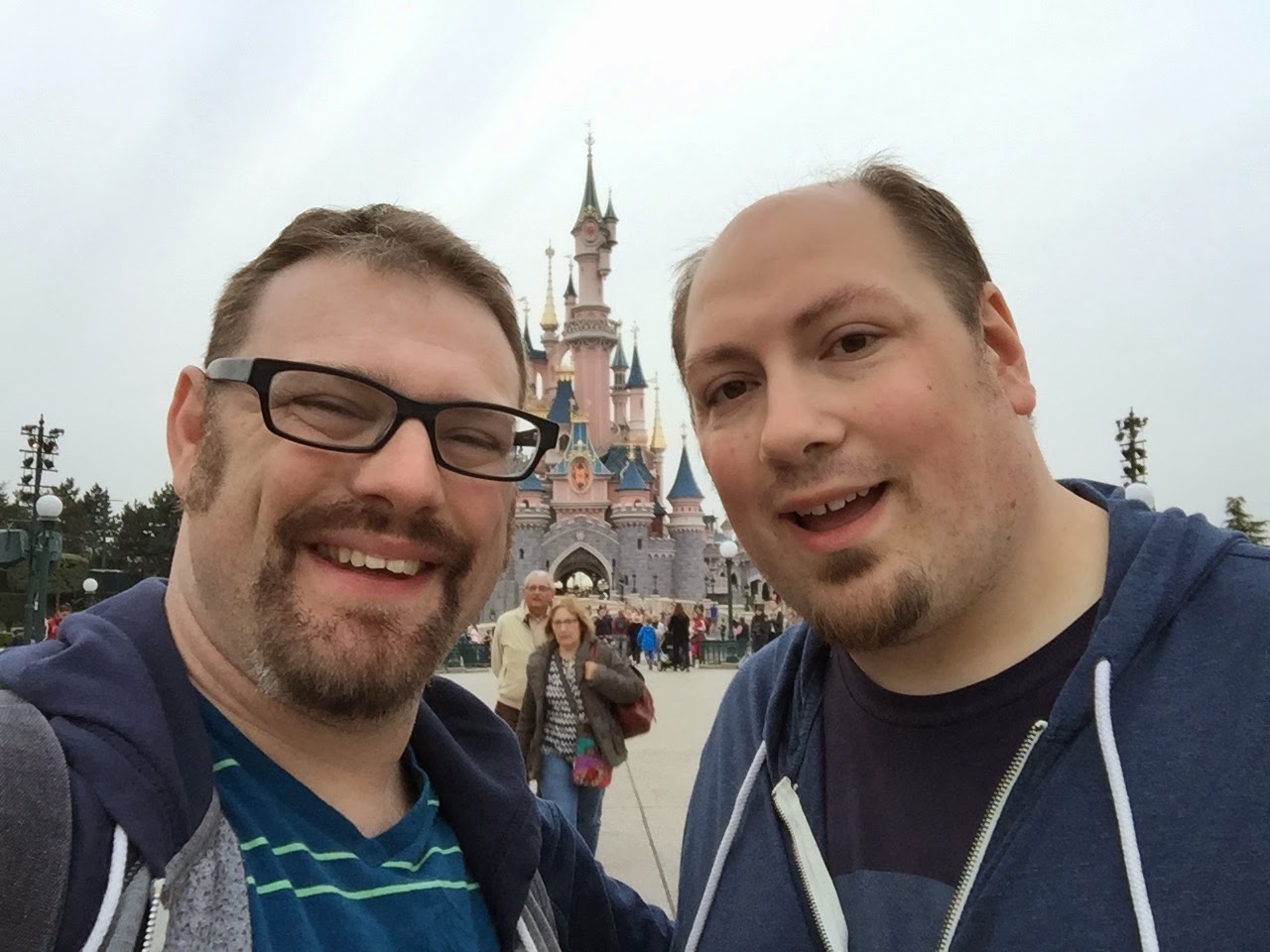
Au Revoir, Disneyland Paris: Paris Part Three

Jeff and I were again up at the crack of dawn for our last day in Disneyland Paris. Everything hurt. My feet screamed at me every time I took a step. I actually had to sit down in the tub to take a shower. My back ached. The sciatic problem in my leg burned like a million wasps decided my tendons were the enemy. We had to walk about twenty minutes to get to the metro station we needed, then get on the train and transfer to the RER in order to get aboard the train to Disneyland.

And it was all worth it just to see that castle again.

It was palpably our final day. We managed to redo all the stuff we’d fallen in love with, especially the whole microcosm of Frontierland, stunningly the best part of either park. We rode the Molly Brown Riverboat – which seemed, indeed, to be unsinkable – and caught glimpses of the Mark Twain Riverboat in dock, which was basically a jumble of splinters held together by warp and woof. I couldn’t resist traveling through Phantom Manor once more, and it kept resonating with me: it’s not only scarier than all the other Haunted Mansions, it’s also a lot sadder. The frontier town buried beneath the house is frightening and fun … but there’s an undercurrent of despair. One of the more desolate notions about revenants is that they’re compelled to repeat the things they did in life. The nature of an attraction like Phantom Manor means that the Audio-Animatronics are repeating everything, over and over, in perpetuity. If you allow yourself into the fiction, allow yourself to be wrapped up in the story, you open up these vistas within. It seemed to me, even though the ride is set on the American frontier, that the emotions and concepts that Phantom Manor conjured are very French: ennui, isolation, and the feel of compulsive déjà vu.

Or maybe I was just sad to be leaving.

We rode the carrousel, and Jeff’s tradition of naming his favorite horse continues. I don’t remember his name, except it was obviously clever and luxurious. The name for my horse? Necromancer du Poulet Rôti. Jeff howled for hours at that one.

You want to know one of the coolest things about most of the attractions? They figure out a very interesting way to make it in French and English. Like the Ratatouille ride. At one point, Remy is trying to choose between three dishes. He mentions the first one in French, the second one in English, and then the third one is a mix. During the nighttime show, Dreams (which is a cross between World of Color in California Adventure and Wishes … sort of. There’s water projections and explosions and it’s all really fantastic.) Peter Pan and Wendy are talking; Peter asks a question in English, Wendy answers in French, Peter reiterates in English. It’s the least invasive way of being bilingual ever.

Speaking of invasive and being French: were you aware that cutting in line is actually a French thing that people just do? It’s not discouraged. But by the last day of our trip, Jeff and I were pretty dang sick of it. We got to the Studios at open, and … I mean, both Crush’s Coaster and Ratatouille were down, nobody had any information as to when they’d be open, and no one really seemed to care. Ah, Paris. Anyway, we made the best of it and made our way to the barren asphalt wasteland that surrounds Rock N Rollercoaster, got in line, and were immediately beset upon by these three underage line cutters. They were behind us and kept trying to force their way ahead. Jeff turned to me. “We’re not letting them by. This is our time!”

I agreed, and we did everything we could to passive-aggressively block their really unsubtle ruse. At one point, the younger girl and boy locked eyes with Jeff and I, and there seemed to be something of a grudging respect there. They knew they’d been bested. Also, when they saw the coaster cars take off at the speed of sound, it was obvious it was that it was their first time there. The girl, in English, shouted, “Oh, SHIT.” Jeff and I then liked them from there on out.

We didn’t want to leave, that was the thing. We eventually got to ride Ratatouille together for the first time, which was c’est magnifique (a phrase I used more often than one might deem necessary). I rode Crush’s Coaster solo and desperately wanted to go on again (but then they were closed, except they weren’t, well maybe they were, no one knows). We rode Big Thunder in the daylight, which meant that the tunnels to the island it’s on felt darker, but the ride itself just isn’t as awesome in the daylight (this is true for all Big Thunders). We discovered that the Indiana Jones coaster, which has a great queue but barely a theme on the ride itself, is a lot better in the front seat. We ate at the Golden Nugget and discovered that the food there was actually passable. Not good; heavens, no! There is no good food at Disneyland Paris, at least in our experience. We didn’t eat at Cinderella’s Royal Table yet, but maybe next time.

Our last event on our itinerary before heading back to the apartment was Buffalo Bill’s Wild West Show. We’d heard raves and were really excited to try it out. Only when we got into the holding area did we realize that the people raving must be lunatics. For the first time, the language barrier, the crowds, and our encroaching exhaustion had begun to catch up with us. We had no idea where we were being seated – a CM in broken English explained it as, “You will have seats. The red section.” Unfamiliar with the setup, I didn’t know where the red section was. Nothing was labeled “the red section.” I was suffering under the added indignity of not always knowing what red is. When eventually we were seated, it was in these stadium seats that were so uncomfortable it was as if we were being asked to feel the simulated effects of saddlesore.

The food came intermittently. No one ever told us how we would be fed, so when half our section got dinner and we didn’t, I wanted to cry. Jeff was just over it. Eventually – an hour into the show – our ribs and chicken were doled out and we dug in, not even caring how bad the food was. But TWIST: the food was fantastic. It was without a doubt the best food I’d had in France thus far … excepting, of course, that long-ago Roquefort. Oh man, I wish I was eating that Roquefort now.

As for the show? Well, it made very little sense. It was set up like a sporting arena and there were simulated stagecoach robberies and at one point we all had to pass a soccer ball around, I THINK? Around the hour and a half mark, actual buffalo thundered out onto the field, and that was pretty cool. I don’t remember much. I was falling asleep and dreaming of Roquefort. The family next to us just stared ahead and had no expression. Jeff thought they were plants. Or robots.

Despite the drawbacks – the bad food, the almost hilarious lack of customer service at times (and I will stress that it’s at times; most of the people there were as kind and courteous as the CMs in America), the oddly shoddy paint jobs in some areas of the park – Disneyland Paris enchanted us. It was different enough, and awesome enough, for us to seriously consider returning before our annual passes are up next April.

But those are dreams for another day. Stumbling out of the parks and onto the train, the thought hit me: I’ve seen Disneyland, but now I’m going to see Paris. Leaning back into my seat and grinning at my friend, I couldn’t help but have a little thrill at what might come next.

NEXT UP: OUR RELIGIOUS EXPERIENCE

Wednesday, May 6, 2015

I’ll Never Be Sober (Kickstarter poem)

I’ll Never Be Sober

across the table you’ve got your sipping whiskey
the way it passes your lips, splashing over your teeth
I want to fight you for your glass of sipping whiskey
I want to knock some reality into your disbelief

I never drink except when I do
I never know which me I’ll get
sometimes it’s fun times screaming rock and roll
sometimes its fighting and fucking and endless regret
I’ll never be sober in this life
I’ll never not crave oblivion
is heaven an escape from my stupid consequence
or is it just a break from this hell I’ve been living in?

watching you drink is like watching you fuck
the more you do it, the more you let go
you don’t want a drink and you don’t want me
but get some of both in you and you stop saying no

I only drink when I can’t stop myself
fire in my gut, blitzkrieg in my mind
the numbing release of whiskey down my throat
the sweat on your back as we start to go blind
I’ll never be sober even when I don’t drink
I always want more than I can take
I’ll always want you more with whiskey on your breath
I’ll always want to find out just where we’ll break

there’s something broken in me that wants you to suffer
is it me or the drinking that drives me to violence
whiskey makes it easier to contend with myself
whiskey makes it easier for you to take it in silence

I never drink because I can’t stop when I do
this wrong inside me isn’t just alcohol
there’s a darkness outside that I’m always lost in
there’s a pit inside me and I can’t stop the fall
I’ll never be sober and that’s just fine
it’s easier to live when I can’t think
I don’t want to break the cycle of pain and despair
I’m already breaking
good god I need a drink

Monday, May 4, 2015

My Favorite Crush: Paris Part Two

This was our plan: on my first full day in Paris, Jeff and I were going to wake up at 5:30 AM and beat feet to Disneyland, in order to get there in time for Extra Magic Hours. EMH works differently in DLP than at either WDW or Disneyland in Anaheim. All you needed was the annual pass, which we had cleverly purchased the day before, and you could get into Disneyland two hours early. Two hours! How cool was that!

You couldn’t get into both parks early, sadly, and the only lands open in DLP that early are Discoveryland (the steampunk version of Tomorrowland that looks like you’ve stepped into Jules Verne’s fever dreams, in a good way) and Fantasyland, which has all the dark rides, except Dumbo which is under refurb, and “it’s a small world,” which isn’t, but which is inexplicably closed during EMH. Jeff was cool with it; we were able to ride Peter Pan right off, and if you thought the starfield was cool in Disneyland Anaheim, it just goes on and on and on in Paris.

We rode the Carousel, Snow White and Pinocchio (neither of which I can get at WDW), and the teacups before heading into the Castle to have a walkaround fantasy. Did you know there’s a cavern underneath the castle, and a dragon there? A freakin dragon that breathes smoke and has glowing eyes and flapping wings? THERE IS A DRAGON UNDER THE CASTLE. Points to France. We have dragons but only in parades and shows and stuff. A dragon. Wow.

Our big plan was to get to the Studios park as soon as it opened at 10:00 AM. Our first attempt to get in was met with incredulity by the French cast member, who tried to scan our tickets … then moved to another turnstile when they wouldn’t beep. We moved with her, thinking this was her intent. It wasn’t. “Hello?” I called. “Bojour?” Oh, she was there. She heard us. She was just ignoring us.

Jeff asked, “Did she just … stop doing her job in the middle of helping us?”

I nodded at him. “Oh, oui.”

Eventually we got into the Studios, and … how to describe it? The Studios contains four of the best rides in all of Disneyland Paris, and they’re surrounded by a park that can’t be bothered to attempt a theme. The era of the “studio park” is a little tired at this point regardless, but man does the Studios just not try. Immediately, we made our way over to the Ratatouille mini-land, and THAT was charming. It was like the best possible idea of Paris in miniature. The line for the ride snaked out fifty minutes, but either Parisians aren’t as familiar with the concept of Single Riders or there was just no one utilizing that space, we took full advantage. Ten minutes after getting in line for the most popular ride in either park, we were clambering into our vehicles.

I … had some problems with the Ratatouille ride the first time. I think part of it had to do with the hype and part had to do with the cognitive dissonance. It overwhelms your senses. The vehicles move independently, and you get the feeling of being shrunk down and catapulted into a non-stop frenzy while being the size of a rat. It felt almost unpleasant on my first go, the same feeling I got from the Spider-Man ride at Universal the first time I went there. We went on again almost immediately and I realized how much I liked it. We went on a THIRD time and I loved it.

It wasn’t the only thing I loved. Like I said, there’s basically no connective tissue in the Studios, but man are the rides pretty amazing. Tower of Terror is not really any different from the one in Anaheim, but it was still terrific. Rock n’ Rollercoaster, however, is very different, at least in its intent. The ride in WDW has you shooting through Los Angeles after a video of being in the studio with Aerosmith. The one in Paris is … ah hell, why not say it? It’s impressionist. Aerosmith calls out that it’s going to be a roller coaster; the linear “story” is gone. Then you launch and it’s the wild, cannonballing effect of actually being at a concert, done with lights and sound and speed. None of the standup signs that suggest a place; this is all going on feeling. It’s a change in intent but man is it effective.

But none of it compares with Crush’s Coaster, which should be just … just not as goddamned good as it is. It’s just a regular coaster with a spin in the dark, but it manages to be scary, and fun, and exhilarating all at once. Jeff and I waited in line for over an hour to get on it and it was worth every second. We even tried to get back later, but … well, I don’t know if it’s the Studios or France, but first they said it was down for the rest of the day and there was no point in waiting, and then they said it was open again but not the single-rider line, and now the line had stretched another hour. Damn you, Studios!

Back at the regular park, we showed up for our wonderful meal at the absolutely beautiful Walt’s. Each dining room is made up to invoke each of the lands in Disneyland. Originally they put us in the Fantasyland room, which was packed with whimsy, but it was next to a window and it was too hot so we moved over to the Main Street USA room. Beautiful: vintage, a little bit steampunk (every place in Disneyland Paris is a little bit steampunk), and cozy. We were so excited to be there. After so much inexplicably terrible food at Disneyland, we were ready for this place, which got high marks from almost everyone.

Boy howdy, was the food awful. Jeff got … I don’t remember what Jeff got. I got marsala chicken, which turned out to be a cooked(?) chicken breast sitting on top of a thin rime of marsala sauce. I’ll say this: the sauciers at DLP are pulling more than their own weight, because this and the sauce at Blue Lagoon were both amazing. That chicken, though? I didn’t know you could actually make meat both dry and damp at the same time.

As we were leaving the park that night, we came across one of Paris’ weird passions: flavored Lay’s potato chips. I picked up a bag that said poulet roti – rotisserie chicken.

It was the best food we’d had all day long. We devoured that bag on the long, long train ride home. My feet were explosively in pain. My brain was eager to shut down. My body was at the edge of exhaustion. And we had to be awake in six hours to do it all again one last time.